

What's involved in a professional skin cancer check?
Your doctor will discuss your concerns and determine factors that personally increase your risk of skin cancer. A dermatoscope is used to inspect your skin from scalp to toes, front and back. A personalised plan, appropriate follow up and possible treatment will be arranged.
Regular self-skin checks: What's the point?
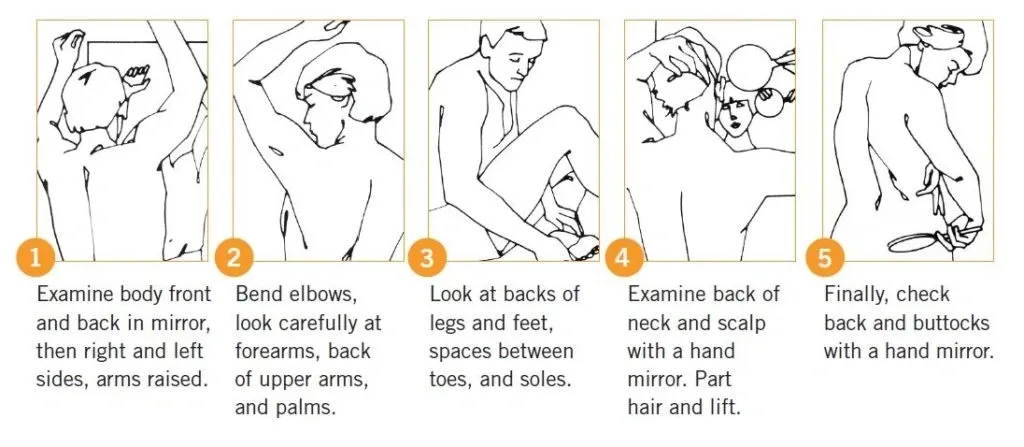
Looking at your own skin from head to toe, front to back, every 1 to 3 months, helps identify skin cancers early.
Early detection of skin cancer reduces the chance of surgery or, in the case of a serious melanoma or other skin cancer, potential disfigurement or even death.
Make sure you look everywhere, even where the sun doesn't shine, as not all skin cancers are due to sun damage. Therefore look between your fingers, toes, palms, soles of feet, armpits, groin, buttocks as well as under your fingernails and toenails.
If you don't look (at certain areas of your body), you won't know (if a skin cancer is present)!
The SCAN framework
Using the SCAN framework will help you detect skin cancers early.
As you SCAN your skin, think of SCAN (Sore, Changing, Abnormal or New):
Sore:
A spot which is either sore, scaly, itchy, bleeding, tender and doesn’t heal within 6 weeks.
Changing:
in size, shape, colour or texture, especially over a short period of time (like a few months).
Abnormal:
If a spot looks or feels abnormal to your "family of spots", it's an "ugly duckling"!
New:
Spots appearing on your skin recently, especially if you're over 40 years old!
If you find a spot or mole of concern that has one or more of the SCAN features, book in a “spot check”, or a full skin check (if you have not had one recently).